Te Marae Kura o te Kura Tuarua o Onehunga
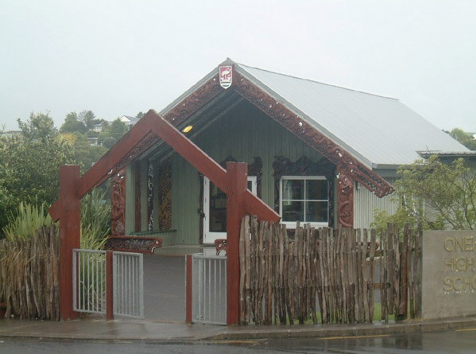
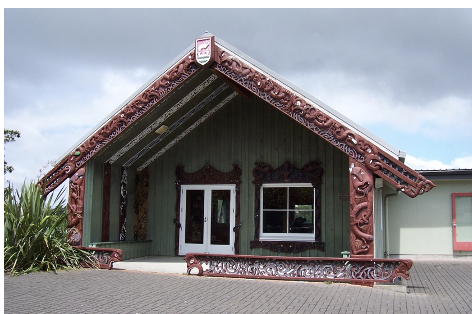
In Te Reo Māori Week it is appropriate to celebrate Te Haerenga, our marae. In February 2026 we will celebrate 30 years with our marae.
The idea of having a Māori space and visible recognition of Te Tiriti o Waitangi obligations was raised by Kay Hawk with school leaders and the Board of Governors in 1988. Implicit in the development of the process was the idea that the marae was to be a Marae Kura as distinct from a Marae Tūturu (traditional marae) or iwi marae. It was to be a place of learning first and foremost, a place for the promotion and protection of the Māori language.
The Marae Kura Constitution approved by the Board of Trustees in 1994 stated that the guiding purpose or kaupapa of the marae is for:
- The betterment and wellbeing of all who may enter its precinct.
- The enhancement of the culture of Onehunga High School.
- To provide a focal point for tikanga Māori as part of the bilingual and bicultural policy arising from the Treaty of Waitangi and Tino Rangatiratanga.
- To create and establish a truly New Zealand identity where the marae provides for the wellbeing of all ethnic groups.
In 1989 with Tomorrow’s Schools a new Board of Trustees was elected and embedded Treaty of Waitangi obligations into the school charter. Contact was made with the intermediate school and contributing primary schools. With the net cast wide amongst key Māori parents as well as Pākehā parents, a Komiti was formed to progress Māori initiatives within the school.
The marae Komiti was formed and began to meet regularly. It comprised a Chair, the Principal, Te Reo teacher, Māori Board of Trustees representative and representatives from the Board, students, parents and staff. During the period 1990 to 1993 the pre European history of the area was researched. Contacts were established to clarify who the mana whenua were (Ngāti Whātua and Tainui). Advice was offered by Tainui (Te Puea Marae) and Ihumātao. Extensive consultation and advice was sought from other schools who already had whare wānanga and marae. Both the University of Auckland and the Teachers College provided guidance.
The tikanga, management and rules for its use were formulated and the Board of Trustees ratified the Constitution in 1994. Tenders were sent out and Jasmax was appointed as the architect and builder. After much discussion and consultation the current site was chosen and feedback and objections from neighbours were addressed. The resource consent process with council was a difficult and trying process. Extensive correspondence is on file about how the marae would be used.
When considering the naming of the marae, the committee recognised the historical importance of the area, the land being used as a pathway for the Tainui canoes, and secondly it defined the journey through the school and through life. The name Te Haerenga – The Journey, and the themes depicted in the carvings, embody the significance of the learning process in the lives of students as well as the significance of the school’s location.
We were fortunate to have Toi (Gordon) Hatfield as the carver. The design of the carvings adorning the Wharenui support the concept of Te Haerenga. A few selected aspects highlight the thematic approach adopted. The carved maihi or bargeboards depict the figures of Tūmatauenga and Hineahuone. Alongside Tū are the figures of Te Whakamārama, The Enlightenment; Te Hiahia, The Desire; and Te Whainga, The Pursuit. Each of these encompass the traits associated with learning as do the figures alongside Hineahuone: Te Tautoko, The Support; Te Kaha, The Inner Strength; and Te Whakaritenga, The Destiny.
Te Haerenga has grown to become an integral part of the school. Through its physical presence, its visual impact and its position at the entrance to the school it is clearly so. Yet it has become more than a recognisable structure, its role having evolved so that it is now part of the life of the school.
Thank you to Dr Kay Hawk and Murray Saunders for help with this article.
John Pipe - Onehunga High School Archivist